Translation
A ball moving from right to left.
Ours

Baseline

Current video diffusion models generate visually compelling content but often violate basic laws of physics, producing subtle artifacts like rubber-sheet deformations and inconsistent object motion.
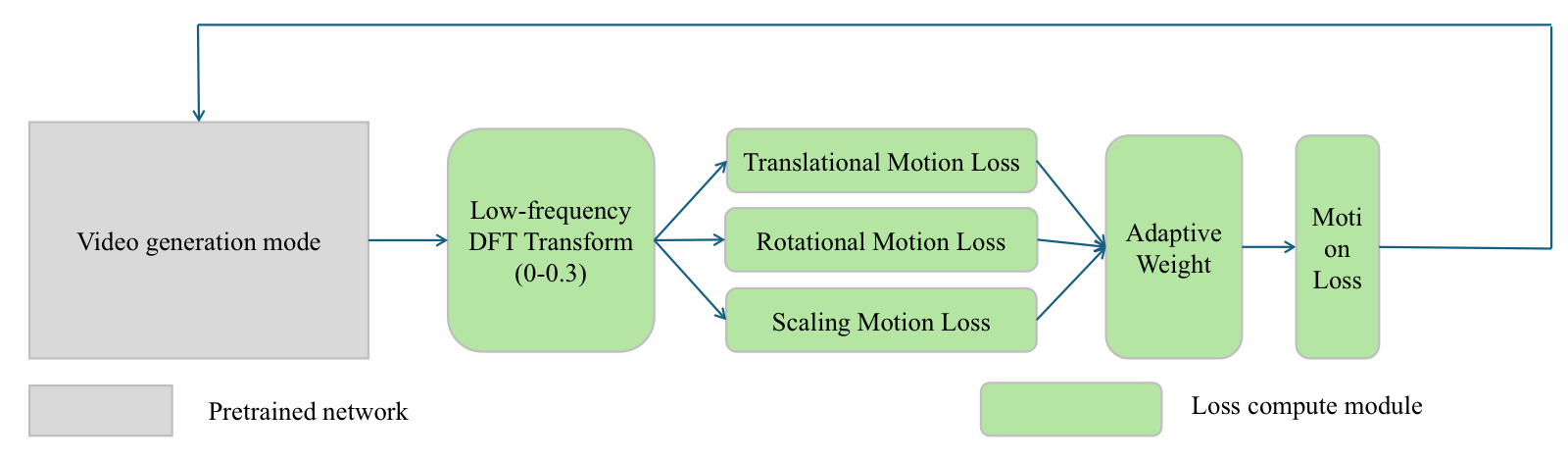
We introduce a frequency-domain physics prior that improves motion plausibility without modifying model architectures. Our method decomposes common rigid motions (translation, rotation, scaling) into lightweight spectral losses, requiring only 2.7% of frequency coefficients while preserving more than 97% of spectral energy.
Applied to video diffusion backbones such as Open-Sora, MVDIT, and Hunyuan, the loss improves motion accuracy, temporal consistency, and text-video alignment while maintaining visual quality.
Below are representative frame strips. The proposed loss produces smoother, more coherent motion than the baseline on simple projected motion prompts.
A ball moving from right to left.
A freight train arcs through a canyon.

